



credits
Designed
Programmed
Graphics
Music
Publisher
Community Rating
Average rating 0 / 5. Vote count: 0
No votes so far! Be the first to rate this game.
BACK OF THE BOX
N/A
trivia
“Alea” is an arcade game by José Oliveira and Ricardo Silva.
Info from Planeta Sinclair:
In 1987, “Alea” was the first of the games to be developed, and it is also the one that is closest to a saleable commercial product and with a chance of being successful.
The game was already programmed by José Oliveira, when Ricardo Silva started his collaboration, being responsible for the loading screen and the music.
One of the curiosities of this game, rarely seen in other Portuguese programs, is the use of synthesised voice, which was used in other Code Masters games.
The graphics themselves include ideas taken from other works (eg the loading screen is clearly Equinox-inspired), although they also contain many original elements.
It should also be noted that some chords from the music on the initial menu, created by Ricardo Silva (who considers it his favourite).
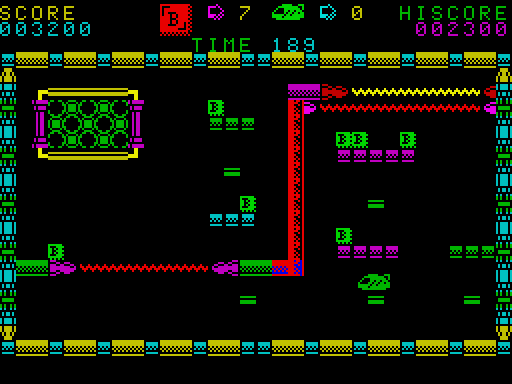
In “Alea”, we then control a spaceship, which aims to collect all the energy cells displayed on the screen (each screen corresponds to a level), in a short time, before moving to the next level.
The traps and obstacles are immense and varied, in a futuristic tone, making the challenge very difficult, requiring a lot of experience to advance through the levels.
These are arranged in 10 towers, each containing five floors, for a total of 50 levels.
At a certain point, the scenarios are repeated and, from level 51, the towers are no longer numbered (starts at tower zero, ending at tower nine), assuming that the game has no end.
This is one of the weaknesses, as it would be more interesting for the game to have an end, even forgiving the fact that there is a repetition of scenarios.
The collision system also needed a little tuning (the ship is always facing to the left – the programmers have never been able to solve this problem), meaning that it is not always possible to collect the energy cells when we touch them.
It’s also not easy to jump at the exact moment to the moving platforms, causing many lives to be lost until you get the perfect jump timing.
However, despite the mentioned minor nuances, the game is tremendously fun, reminding me of some of the (good) games in the budget category released by publishers such as Mastertronic, Players or Code Masters.
It would in no way tarnish the catalogue of these publishers, and it really was a shame they couldn’t get it commercially released.
The graphics, integrated in a futuristic environment as we have already mentioned, are quite pleasant, with an interesting use of colour, avoiding attribute problems as much as possible, except when we are under the energy cells.
In addition, the scenarios created are challenging as well.
Of course, after some time, after running them several times, we already got the hang of it and we know the trick to pass them.
But until you get to that point, a lot of ships will roll, as we only have three lives and those run out almost as fast as the time we have to complete each level.


downloads
101 Downloads
Warning: Trying to access array offset on null in /home/sites/10b/c/c8b441487d/public_html/wp-content/plugins/elementor/includes/widgets/video.php on line 1203
game tips
N/A


